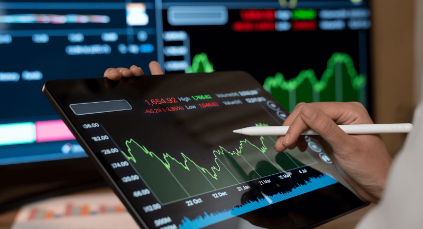
Learning how to read and analyze charts is the most important skill anyone must have before entering the foreign exchange market. For someone who is a beginner in forex trading, using the so-called charts becomes the foundation for learning how the price of currencies moves and hence help direct traders the right way by avoiding guess work from the market. Fortunately, platforms like MetaTrader 5 (MT5) facilitate this process through their powerful built-in analytical tools known as MT5 indicators. These indicators can enable traders to spot trends, measure momentum, and indicate possible entry and exit positions accurately and convincingly.
1. Basic Reading of Forex Charts
This is how forex trading is represented by a chart, which in many cases, it will present price changes in pairs of currencies, for example EUR/USD, GBP/JPY, or USD/JPY, which have moved at a certain period. Such charts allow traders to analyze patterns and predict the direction in which the market might go in the next move. Most common chart types in forex trading for beginners include:
Line Charts: These are connected via closing prices over a particular time period and give a very simple overview regarding the market direction.
Bar Charts: These consist of the open, high, low, and close futures of every time period, thus giving a deeper detail about market volatility.
Candlestick Charts: The most popular among traders. A single candlestick indicates price movement during a selected time frame, and thus demonstrates whether buyers (bulls) or sellers (bears) dominate the market.
In fact, candlestick charts are of great help to the beginners because they can show clearly the emotional aspect of the market and market trends. If one can understand the candles and their patterns, that person is able to understand the value behind a price action.
2. The Role of MT5 Indicators
MT5 Indicators: these indicators build up price into some meaning for the trader. The indicators built into MetaTrader 5 use mathematical formulae to scrutinize past price movements and forecast related future trends for the trader to assist them in defining points at which trading entry or exit might be executed.
The following are the two main indicators on MT5:
Trend Indicators: These indicators show the general trend on the market: uptrend or downtrend.
Oscillators: measure market momentum and indicate when the market has become overbought or oversold.
These indicators for forex trading for a beginner have already removed most very emotional things in decision-making, and you are just going to depend on real data.
3. Major MT5 Indicators Every Beginner Should Learn
Among the numerous MT5 indicators, the following are of great use for a beginner trader learning to read forex charts or analyze them:
1. Moving Average (MA):
Simple-yet-powerful indicator for smoothing price spikes to see the broader trend, i.e. price over the MA indicates a stronger probability of an uptrend while below it suggests a downtrend.
2. Relative Strength Index (RSI):
RSI determines price momentum by seeing how fast and far the price moves. Above 70: overbought market, sell signal possible; below 30: oversold market, buy signal possible.
3. MACD (Moving Average Convergence Divergence):
The only indicator merging knowledge of momentum through the trend analysis. Bullish is when it crosses above the signal line while bearish is when it’s beneath.
4. Bollinger Bands:
Shows market volatility through three lines: in the middle there’s the moving average while two outer bands show high and low. The touching of price from the upper band indicates an overbought market while touching the lower band indicates an oversold market.
5. Stochastic Oscillator:
This compares the closing price to a range of past prices, highlighting potential reversal points when the market is overbought or oversold.
4. Learning How to Read and Analyze Charts Using MT5 Indicators
Once one knows about chart types and indicators, then are these combined. Here are the ways a beginner may use MT5 indicators:
Select Time Frame: The time frame should correspond with your trading style. For beginner traders, it’s mostly one-hour or four-hour charts because they easily read trends without much noise.
Finding Trend: Test any Moving Average on price or MACD to find out whether the market has gone up or down. Your probabilities of success will be enhanced through trading in the direction of the trend.
Proving by Oscillators: Use RSI or Stochastic Oscillator confirmed whether the market might still have the momentum to continue its trend.
Mark Support and Resistance Levels: Draw horizontal lines at past highs and lows. These are levels that serve as barriers where price movements often pause or change direction.
Waiting for Breakout and Reversal: Price breaks above resistance or below support and the move is confirmed by the indicators, and as such a new trading opportunity is likely.
Keep Charts Simple: Do not over-clutter your chart with too many indicators. Just two or three reliable MT5 indicators are enough to give clear understanding.
5. Practical Forex Trading Tips for Beginners:
Start Using a Demo Account: Learn to read charts and use indicators without risking real money.
Concentrate on a Few Currency Pairs at a Time: Understand how a certain few specific pairs would move rather than just jumping into the other pairs.
Maintain a Trading Journal: Record your trades, strategies, and indicator settings to identify what works best.
Keep Multiple Indicators: Follow your analysis, not your emotions. Allow your MT5 indicators to guide your decisions.
Conclusion
Understanding reading and analyzing charts is, for every budding forex trader, the basis of successful trading.
MT5 indicators will greatly ease this journey by transforming complex price data into clear visual signals. Tools such as Moving Averages, RSI, and MACD will enable trend detection, momentum assessment, and confident judgment about entry or exit points. Thus, with time, patience, and discipline, a beginner can develop accurate reading and interpretation of charts and trade more strategically. Learning to read and analyze MT5 graphics would soon become second nature for helping you make smarter data-driven decisions in the dynamic forex market.